J/40
The J/40 still a favorite blue-water boat
When you think about J Boats, most sailors do not immediately draw an association to "blue water boat." Instead, what comes to mind is racer, regatta winner, young macho sailors and big, strong crews — you know, the ones in polo shirts and Mt. Gay hats.
In part, this is true. J Boats have proven over the last two decades to be consistently good performers around the buoys and winners in point to point events. So, part of the image is based in reality. But part is also based on product positioning — that artful manipulation of the consumer's perception that, in this case, has many sailors believing that no matter what boat Rod Johnstone draws next, the one constant is high performance.
Obviously, the company's image was skillfully created by Bob Johnstone (brother to Rod). J Boat, Inc. is one of the few American boat builders that has prospered through the marine industry recession. But what has been left out of the overall J Boat mystique is that several, if not many, of Rod Johnstone's designs are also excellent cruising boats that are safe and fun offshore passagemakers. Now and then, J Boats brings our a model with a "C" attached to it — the 34C and the 37C, for example. These have been fast, fun boats with a good motion at sea and the accommodations for comfortable cruising.
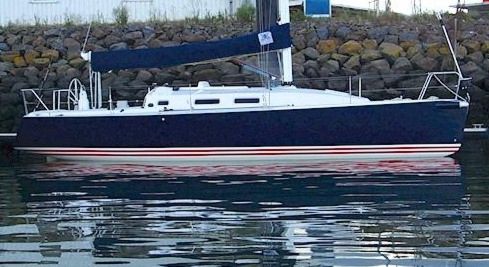
But of all the boats the Johnstones have brought to market, our favorite bluewater boat is the old J/40, designed in 1983 and first launched in 1984. Since then, more than 100 of the boats have been built and several have undertaken notable offshore cruises. Today, well-equipped J/40s can be bought for under $130,000, which is a lot for a used 40-foot boat, but close to $100,000 less than the new J/42 that has been designed to replace it.
Compared to other boats in this size and price range (the Tartan 40, Nordic 40, Bermuda 40 and Bristol 41) the J40 is notable for its simplicity, speed and ease of handling. J Boats are rarely the least expensive of their class. Yet, they almost always represent good value for money and consistent value over time.
There have been a few milestone 40-footers over the years. The Cal 40 was certainly one and we believe the J/40, in the same vein as the Cal 40, has proven to be another.
The Numbers
Offshore performance is always a compromise between comfort, sea-keeping ability and speed. Weigh a design too heavily toward one of the three and the resulting boat will be a dog of some kind or another, either fast and uncomfortable, or teak- and velvet-lined and slow. And if sea keeping, (the ability to weather a storm without coming apart) is ignored, the resulting boat will be the worst sort of mongrel — an unsafe one.
With a displacement/length ratio of 219, the J/40 falls at the light end of the spectrum for offshore, live-aboard boats, but is in fact about average for modern (1990s) coastal cruisers and racer-cruisers, particularly those designed and built in Australia-New Zealand and Europe. At 219, the J/40 has enough heft to carry its way through a chop when beating to windward, often the worst point of sail for light boats. With short ends and a fine entry, the hull is nicely balanced, so teeth-jarring slogs upwind don't result in hobby horsing. In 15 knots of breeze, the boat will claw upwind at 6.5 knots or better and will tack through 60 degrees apparent wind.
The rig of the J/40 is of quite low aspect for a boat designed to sail quickly. The concept in the design is to have a boat that will sail well under main alone and effectively with a 120 percent or even smaller genoa. The sail area/displacement ratio of 16.2 is moderate by modern standards, although in 1984 such a ratio would have been considered on the high side for a cruising boat. Times have changed. The point, however, is that an easily-driven, moderate hull, with a moderate fin keel and large spade rudder can be powered by a rig that is not a man-eater. All part of the compromise, and here it turns out very nicely.
Part of the performance picture is the beam/length ratio of 35 percent in the J/40, which is an indication of hull volume (good for carrying loads such as books, cans, water, fuel and so forth) and initial stability, which is good for upwind performance but can also be an indication of a short, jerky roll off the wind. The J/40's ratio is higher than will be found on more traditional designs, but hardly extreme. Modern IMS boats and new long-range voyagers such as Bob Perry's new Saga 43 are tending toward narrower hulls, making them easier to drive and quicker. But the trade-off with a narrow hull is 15 to 20 degrees of heel upwind. The J/40 is happiest and fastest when sailing more upright than that, preferring heel angles in the neighborhood of 12 degrees or less, a preference shared by many an offshore sailor.
A performance boat that is defined not by its extremes but by its consistent moderation in design and rig, the J/40 will do several things well, most of all sail. In variable conditions, the boat should average 140 to 160 miles per day at sea. Reaching and running in the Westerlies or Trade Winds, the boat should tick off 175 to 190 miles a day regularly, with occasional exhilarating runs of 200 miles or more.
Construction
J Boats is not a boat building company, but a marketing and sales outfit. All of their boars are built by Tillotson-Pearson in Warren, Rhode Island, known for its long boat-building history and dedication to the art especially the science of reinforced plastic and composite construction techniques. These are not exotic boats, built of ultra lightweight anything. They are sensible production boats built with good materials and proven techniques.
The most notable feature about the J/40 hull is the balsa coring of the hull and deck. Cored construction provides very high strength-to-weight ratios, which means that weight in the form of ballast can be applied where it does the most good for the keel — instead of spread throughout the hull. Concentrating the weight amidships enhances performance and dampens pitching. But light weight is not the sole advantage of cored construction: coring makes composite panels extremely stiff, allowing for greater rig tensions and overall hull strength. Additionally, coring acts as both sound and temperature insulation. In stormy conditions, the aft cabin provides a terrific sanctuary from the whine of the wind in the rigging and the whoosh of waves. In cold climates, the coring will also eliminate condensation inside lockers and cabinets, which inevitably leads to mildew and must.
The downside of balsa coring is the aging process of the composite structure. If a cored boat suffers a serious collision and the coring is violated, moisture will creep into the balsa layer, beginning a rot process that can make the deck or hull spongy and ultimately unsafe. Moreover, if a boat is raced hard and left for long periods with its rig under maximum tension, the strain on chain plates can lead to the destruction of the core fiberglass connection in the surrounding area. When inspecting or surveying a cored hull and deck, sounding with a hammer and checking for weeping from through-hull and through-deck fittings will give evidence of rot in the core.
J Boats and most other modern composite boats have solid glass reinforcing around all stress areas and areas where deck gear is bolted through the deck. This largely eliminates the ingress of water into the laminate. In the J/40, specific areas to look at when inspecting the hull should be around the rudder post, around the prop shaft's through hull fitting, the partners where the mast passes through the deck and under the stanchion bases.
The lay up of the J/40 is of bi-axial and unidirectional fiberglass, hand laid and laminated with polyester resins. In the outer layer, vinylester resin was used to prevent hull blisters. J Boats and Tillotson-Pearson offer a 10 year warranty against blisters.
Layout and Accommodations
A sailor's boat, the J/40 to be easy and efficient to handle on deck, while comfortable and seaworthy belowdecks. The cockpit is laid out to accommodate a sailing contingent of two couples, but will work well for a lone couple or a racing crew. The main traveler crosses the cockpit just forward of the binnacle, which can make moving to and from the helm awkward. But in this position, the sheet runs from the end of the boom, where it has the most mechanical advantage, and is in a position handy to the helmsman. For those sailing solo or as a couple, this arrangement is excellent. The genoa sheets run to either of the self tailing-winches, which can be handled by one person kneeling on the cockpit seat. The cockpit is well protected from deck wash and with a dodger over the companionway, will be snug in just about all weather. The low bridge deck will keep water out of the cabin should a wave come aboard. If the cockpit has a drawback it is simply that the seats aren't long enough for a tall person to sleep on comfortably.
Down below, the accommodation plan is set up for two couples in two private cabins, each with its own head. While this is a sensible cruising layout, it also works well at sea. The aft head doubles as a good wet locker for those coming off watch. The aft cabin and the two settee berths in the main saloon make excellent sea berths. The galley is set up for cooking underway, particularly with sinks positioned on the centerline so they will drain on either tack. Hand holds are sensibly placed, although the stainless-steel overhead hand rails seem out of place with the rest of the decor. Saloon tables are notorious for breaking away when a large person lurches against them. Although we have not seen this happen on a J/40, the addition of a floor to overhead pole, with the table end attached to it, would solve the problem and add an important hand hold. The forward cabin is as good as can be found on boats of this size, with long, comfortable berths that are wide enough at the forward end for two sets of feet to fit neatly.
Two heads on a 40-foot boat is a lot of heads, considering the amount of time live-aboard sailors spend repairing and unplugging marine toilets. On the J/40 we would consider tearing out the forward head and using the space for spare parts stowage and a work bench. Or, should you want a good double berth, it could be neatly installed forward of the main bulkhead, where the head used to be.
The design has a moderate amount of stowage for long-range sailing. Tanks hold 80 gallons of water and 35 gallons of fuel. We would like to see another 25 gallons of fuel aboard and 20 more gallons of water. Accommodating more stowage is another good reason to rip out the forward head. But it should be noted that in the modern world of offshore sailing, it is rare to be very far from a supermarket, fuel and water supplies, fax machines and a drop off depot for Federal Express. One no longer needs to carry a ton of canned goods, nor all the spare parts in the world, which means that lighter, faster and simpler boats can serve well in far-off lands.
Simplicity and moderation are important qualities in a good voyaging boat. We have long admired the old Cal 40 as a boat that could sail quickly and efficiently and roam the oceans of the world without complication. The J/40, more modern and even more efficient, does all of that and more. Although more expensive than many voyagers can afford, the J/40 will be just the right boat for those who are looking for a performance cruiser with excellent handling capabilities and the quality of both a Johnstone design and TPI construction.
Specifications J/40
| LOA | 40' 4" |
| LWL | 35' 0" |
| Beam | 12' 2" |
| Draft | 6' 5" |
| Shoal keel | 5' 0" |
| Disp. | 21,000 lbs. |
| Ballast | 7,500 lbs |
| Sail Area | 733 sq. ft. |
| SA/Disp. | 16.2 |
| Disp./Length | 219 |
Retrofitting For Voyaging
Using the figure of 20 percent of the purchase price, or approximately $25,000, here's how we would fit out for extended voyaging on a used J/40 that had been bought with standard coastal cruising gear (including refrigeration) already on board.
Sails: Add a 100-percent, high-cut jib to be used when sailing in the Trades ($2,500) plus a storm trysail ($1,200).
Self steering: Wind vane ($3,000), a belowdecks autopilot ($4,250) and an Autohelm 3000 ($750) as a backup.
Safety gear: Six-person offshore raft ($3,500), grab bag ($200), EPIRB ($400), Galerider drogue ($170) and radar reflector ($150).
Anchors and tackle: spare 300-foot nylon rode (3/4-inch or larger) with 50 feet of chain ($160) and two spare anchors of 20 kilos or 44 pounds each ($950), plus a large fluke type (Fortress) ($450).
Electrical system: New batteries, 440 amp/hours on house bank and 115 on the starter bank ($650), a high-output, alternator/regulator/monitor system ($1,250).
Electronics: GPS, built-in with cockpit repeater ($600), spare hand-held GPS ($200), 16-mile radar on stern pole ($1,800), SSB/Ham transceiver with tuner and antenna ($2,250), hand-held VHF ($250).
Miscellaneous: Weather cloths for cockpit, lee cloths for sea berths, sun awning over boom, Bimini over helmsman ($950), cabin fans ($200), and a small inverter ($500).
That comes to $26,330, which is only the first in a series of cost over runs that will precede the final act of taking off to sea.